
Aerial view of an island hotel and surrounding water

Search Visibility

Search Engine Optimization for Search Results and AI Answers

AI is an increasingly important part of travel planning. Travelers use traditional search, direct-answer tools, and AI-generated summaries to understand a hotel. HTB connects SEO, AEO, and GEO so the property's approved facts, useful content, and technical foundation work together. We monitor how the hotel is found and described, document what changed, and recommend what deserves attention next.

Search Visibility

SEO, AEO, and GEO work as one connected program.

Travelers discover hotels through search results, direct answers, and AI-generated summaries. HTB connects the technical foundation, useful hotel content, structured facts, and ongoing monitoring so the property's approved information is easier to find and understand across those experiences.

01 SEO: the search foundation

Be found where the search starts.

Traditional search visibility depends on useful content, sound technical foundations, and each search engine's own systems. As an SEO/AI agency for hotels, HTB reviews the site, addresses agreed technical and content priorities, and monitors what needs attention next. When included in the engagement, HTB re-audits the site on the agreed cadence and reports findings, completed work, and next priorities.

What HTB does

HTB audits the website for technical health, speed, mobile display, indexing, and crawl errors. HTB maps selected searches for the destination and property type to the pages that can answer them. HTB then completes the agreed on-page and technical work, documents what was found and completed, and recommends the next priority.

What it means for your hotel

Travelers can reach current hotel pages and the hotel's own booking path from search. HTB documents the technical and content work completed, then monitors what needs attention next.

Open the full SEO checklist in the detail section below.

Example search results view for a sample hotel: a search results list with the hotel's own result highlighted near the top, beside the technical layers HTB works on each week, shown as simple bars for site health, schema, speed, content and links, and a weekly audit row marked found, fixed, recommended next.
Illustrative example. SEO: the search foundation. The hotel's own page found where the search starts, held up by the technical layers beneath it. No search engine branding, hotel name, or ranking position is shown.

02 AEO: answer-ready content

Be the one answer a traveler hears.

Answer engines and voice tools may surface direct answers from several sources. HTB structures clear questions, concise factual answers, and supporting data so those platforms have better source material. Each platform decides what it displays.

What HTB does

HTB writes and formats hotel content for direct answers: concise summaries, FAQ blocks, bullet lists and tables that make the facts easy to find and check. HTB codes and maintains the schema that marks up rooms, amenities, FAQs and location as data. HTB keeps the same approved facts on the website, in review responses and on the Google Business Profile. HTB tracks whether each new page is indexed and where it sits for the questions that matter.

What it means for your hotel

Clear, structured answers give search and voice tools better source material about the hotel. Those platforms choose their own answers, so HTB monitors visibility and improves the information the hotel controls.

Open the AEO feature set in the detail section below.

Example direct answer view for a sample hotel: a traveler's question card above a direct answer card that names the hotel and cites the hotel's own website, with a structured data tag behind the answer, and the feature set beside it: FAQ content, structured data and entity facts.
Illustrative example. AEO: answer-ready content. One direct answer with the hotel's own page as the source, built from FAQ content, structured data and entity facts. No answer engine, voice assistant, or hotel name is shown.

03 GEO: generative visibility

Be named, and described correctly, by AI.

Generative AI platforms compose their own descriptions of your hotel from what they can find. HTB works to keep that source material accurate, clear and current, then checks a sample of AI answers to see how the hotel is described.

What HTB does

HTB organizes verified hotel information in clear pages and structured fields so search and answer systems have accurate source material. Each platform decides what it indexes, displays, or cites. HTB recommends that the facts on your booking engine, channel manager and OTA listings match your website. Inconsistent names, amenities, policies and location facts increase the risk of inaccurate search answers. HTB tests an agreed set of traveler questions on selected AI platforms through a third-party monitoring tool, on a recurring schedule. The report shows sampled mentions, cited sources, cited pages and factual accuracy. Results vary by prompt, location, account state and time. Where a sampled answer cites a competitor or an OTA and not your site, that gap becomes the next content priority.

What it means for your hotel

HTB works to make the hotel's approved facts clear and consistent, then reviews whether AI answers mention the property, describe it accurately, and cite useful sources. AI platforms control their own responses and citations.

*(Open the GEO monitoring and execution detail in the section below.)*

Example AI visibility view for a sample hotel: an AI assistant answer that names the hotel, describes it with its own facts and cites the hotel's website and listing, beside a monitoring strip with labeled lanes for prompts tracked, sources cited, competitors in view and language checked. No numbers.
Illustrative example. GEO: generative visibility. A sample of traveler prompts tracked on a schedule, with cited sources checked. No AI platform name, hotel name, or count is shown.

SEO foundation. Every item on the checklist.

Twenty working items, grouped into five. Open any panel to see what it covers and why a GM would care.

Audit, keywords and content

HTB reviews the site for agreed technical and content priorities on the documented cadence. Selected searches are mapped to the pages that can answer them, and approved content gaps become recommendations or new work in scope.

Titles, headings, images and links

Titles and meta descriptions are the headline a searcher sees before the click. H1 to H4 structure and image alt text make each page read clearly to a search engine. Internal links guide searchers and search engines to your booking pages.

Addresses, sitemaps and redirects

Clean, readable URLs for every page. Canonical tags and consistent www, http and https addresses so duplicates do not split authority. HTML and XML sitemaps, a robots file, a helpful custom 404 page, a broken link check and a redirection manager so no old address loses traffic.

Speed, mobile, and browsers

Faster, stable pages can improve user experience and support technical search quality. HTB checks representative current phone, tablet, desktop, and browser experiences, then documents issues and agreed fixes.

Search Console, Analytics and schema

Google Search Console, Tag Manager and Analytics are set up in your accounts and monitored. Indexing and crawl errors are caught and fixed. Organization and Local Business schema identifies your hotel as a real, located business.

How the work runs each cycle

On the cadence agreed for the engagement, HTB audits, fixes, writes, structures, requests recrawling where appropriate, and reports what was found, completed, and recommended next. Search engines control crawling and indexing.

Answer-ready content. The feature set.

HTB formats the text for answers first, then handles the technical integrations behind it.

Direct answers and scannable content

Short, factual answers to the questions travelers ask about your hotel. Bullets, tables and FAQ blocks that put the facts where a reader can find them. Accurate, current, expert-written content that reads as trustworthy.

Schema and structured data

HTB's advanced schema coding marks up rooms, amenities, FAQs and location as data. Local SEO schema covers your address, hours and service area. Social profiles are linked to the site's structured data.

Plain-language answers and indexing

HTB writes hotel answers in plain language. No special phrasing for AI or voice search is needed. Where supported, HTB can submit updated URLs through IndexNow and check index status. Submission does not guarantee immediate crawling or indexing.

Tracking, images, video and scripts

A keyword rank tracker shows where your pages sit for the searches that matter, over time. Search statistics and direct search engine integrations feed your reporting. Image SEO, video SEO sitemaps and JavaScript rendering checks make photos, video and script-built content readable in search.

Generative visibility. Monitoring and execution.

Five principles, one third-party monitoring tool, one execution framework, and the four steps only the hotel can take.

The five GEO principles

Credibility and authority: content that reads as expert and trustworthy. Clear structure: readable pages, accurate schema, clear headings, FAQs and metadata. Reputation: genuine guest reviews and factual hotelier responses. Relevance and accuracy: consistent information across your booking engine, channel manager and OTAs. User experience: a site that works well for the traveler an AI sends to it.

Sampled AI answer monitoring

HTB uses a third-party monitoring tool to test an agreed set of prompts about your hotel and your area on selected AI platforms. Brand mentions and sentiment show whether you are named in the sample, and in what tone. Link citation tracking shows which sources the sampled answers cite when they mention you.

Prompts, citation gaps and audit

AI prompt research finds the questions travelers ask that could surface your hotel. Prompt monitoring asks them again over time and compares the answers. Website citation gap analysis shows where a sampled answer cites a competitor or an OTA and not your site. A technical audit checks that the pages are crawlable, indexable and consistent. AI search uses that same foundation.

The execution framework

Six steps, repeated each cycle. Baseline your sampled AI visibility. Monitor the agreed prompts. Analyze citations and sources to see which pages the answers cite. Compare against your comp set to see where they are named and you are not. Report the movement. and turn every gap into a next step.

The client action plan

Update website content: approve HTB's recommendations and supply the facts only the hotel knows. Review your Google Business listing: confirm the corrections HTB identifies, and grant access if you want HTB to keep it in sync. Ask guests for reviews in a neutral way and answer every one. Reviews shape trust and local prominence, and they can appear among the sources an answer uses. Provide current professional imagery of rooms, views and amenities.

What the hotel receives

  • A prioritized website audit, dated and specific to your property.
  • Keyword mapping that ties the selected traveler questions to the pages that answer them.
  • On-page, technical and structured-data work carried out on your site.
  • A Google Business listing review, with corrections identified for you.
  • A technical review and highlight report on the agreed cadence.
  • A sampled AI answer monitoring report: mentions, cited sources, accuracy and gaps for an agreed set of prompts.

Four things only the hotel can do

01Content Approve the recommended updates and supply the facts only you know.
02Listing Confirm the Google Business corrections HTB identifies.
03Reviews Ask for reviews and answer every one.
04Imagery Send current professional photos of rooms, views and amenities.

An illustrative review

See where hotel information needs attention.

An AI visibility review can organize selected traveler questions, hotel mentions, cited sources, and information gaps for discussion and follow-through.

Illustrative dashboard showing AI visibility prompts, mentions, cited sources, and recommended information checks for a hotel.
Illustrative AI visibility review. Monitoring can identify questions, mentions, cited sources, and information gaps; it does not prove demand, bookings, revenue, or causation.
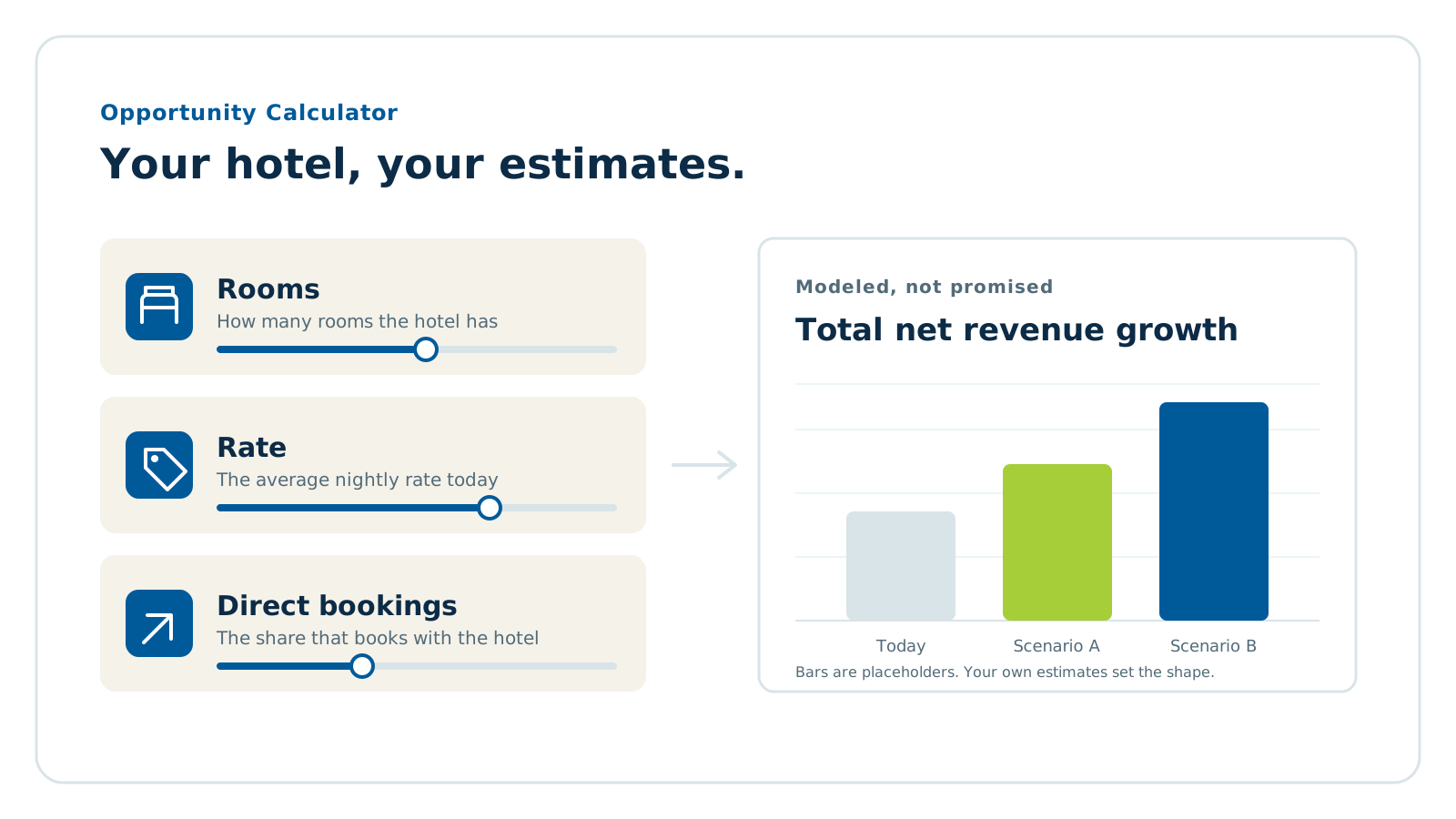
Illustration of the Opportunity Calculator: rooms, rate, direct bookings, and modeled net revenue growth

Opportunity Calculator

See what a shift to direct bookings could mean for your hotel

Enter your rooms, your rate, and your direct booking share to see a modeled view of net revenue, not a promise.

Open the Opportunity Calculator

Questions hoteliers ask

Straight answers on search and AI visibility.

Short answers to the questions we hear most from owners and GMs.

What is included in HTB’s hotel search engine optimization service?

A twenty-item technical and content foundation covering audits, keyword mapping, titles and headings, sitemaps and redirects, page speed and mobile performance, and Search Console, Analytics, and schema setup - plus the AEO content work and GEO monitoring that build on that same foundation.

What is GEO, in plain terms?

GEO stands for generative engine optimization. It is the work of making your hotel visible and accurately described inside AI assistants and AI search. HTB keeps your hotel facts accurate, clear, and consistent, then checks a sample of AI answers to see what they say about your hotel and which sources they cite. Appearing in AI answers is the goal HTB works toward and tracks; no one can promise it, because the AI platforms choose their own sources.

How is a hotel-focused SEO provider different from a general SEO agency?

A hospitality seo agency maps searches to the property and destination questions travelers actually ask about hotels, and connects that work to occupancy and direct-booking goals rather than generic ranking metrics. HTB also folds AEO and GEO into the same foundation, since traditional search, answer engines, and AI search increasingly draw on the same source material.

Do we need to change our booking engine to improve our hotel SEO?

No. HTB works on your website, your content, your structured data, and your public listings. Your booking engine, rates, and inventory stay exactly as they are. HTB does recommend that your booking engine, channel manager, and OTA listings carry the same facts as your website, since conflicting facts increase the risk of inaccurate answers.

How long until we see results from hotel SEO and AI visibility work?

HTB documents when each fix is complete. Search engines decide when they recrawl and update their reports, and that timing varies by page and platform. Ranking and answer visibility build over months and depend on your market and starting point. HTB does not quote a timeline or guarantee a position; what you will see from the first report is the audit and a clear list of what changed.

What do you need from us to get started?

Four things: access to your website and Google Business listing (or a named contact who has it), the facts only the hotel knows - rooms, amenities, offers, seasonal changes - a steady flow of guest reviews with responses, and current professional imagery. HTB does the rest and reports what’s next on the agreed cadence.

What should we look for when comparing hotel-focused SEO providers?

Look for hospitality-specific experience rather than general SEO credentials: a genuine hotel seo company should be able to explain how it maps destination and property searches, how it structures content for AI answer engines, and how its technical checklist ties back to occupancy and direct bookings - not just ranking positions. A provider that treats every industry the same way will usually miss the property- and destination-specific questions that actually drive hotel search demand.

Does hotel SEO typically include AI search monitoring, or is that separate?

It varies by provider. Traditional seo services for hotels often stop at technical and on-page work. HTB includes AEO and GEO - answer-ready content and sampled AI answer monitoring - as part of the same connected program, since travelers increasingly move between traditional search, direct-answer tools, and AI-generated summaries within the same research session.

Search Visibility

See how hotel search engine optimization and AI visibility work together for your property.

Request an opportunity evaluation, or explore the Opportunity Calculator to see what a shift to direct bookings could mean for your hotel.

Request an Opportunity Evaluation